Bolt Opens Search for Government Relations Support
Eight years in, the ride-hailing company is done managing regulators on its own
PARTNER

CRDB Bank Foundation, in partnership with the Green Climate Fund, is selecting businesses working in clean energy, agriculture, recycling, and environmental solutions for funding (Sh500K-200M) and development support.
Secure this opportunity at apply.fursahub.com.
Deadline: March 11.
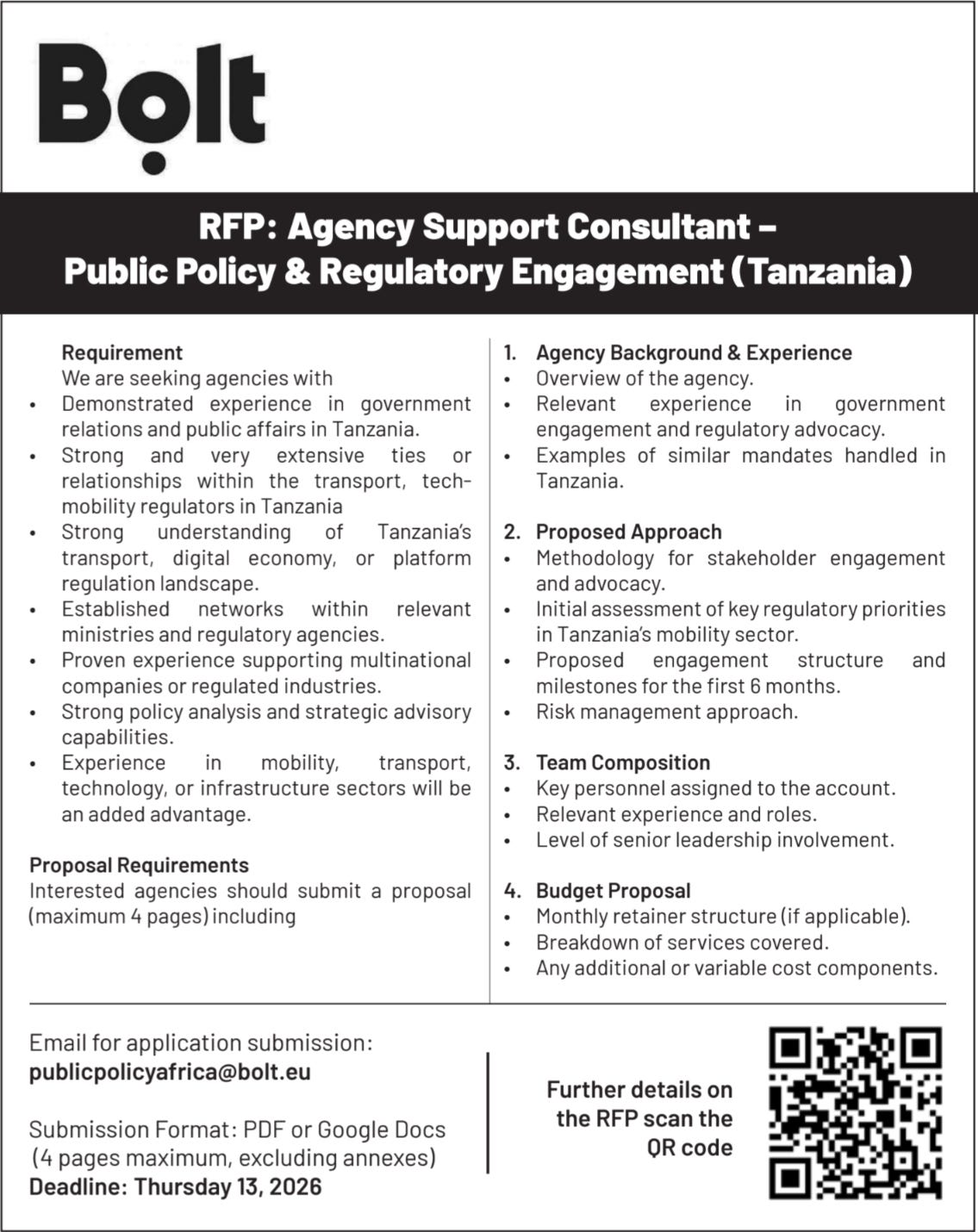
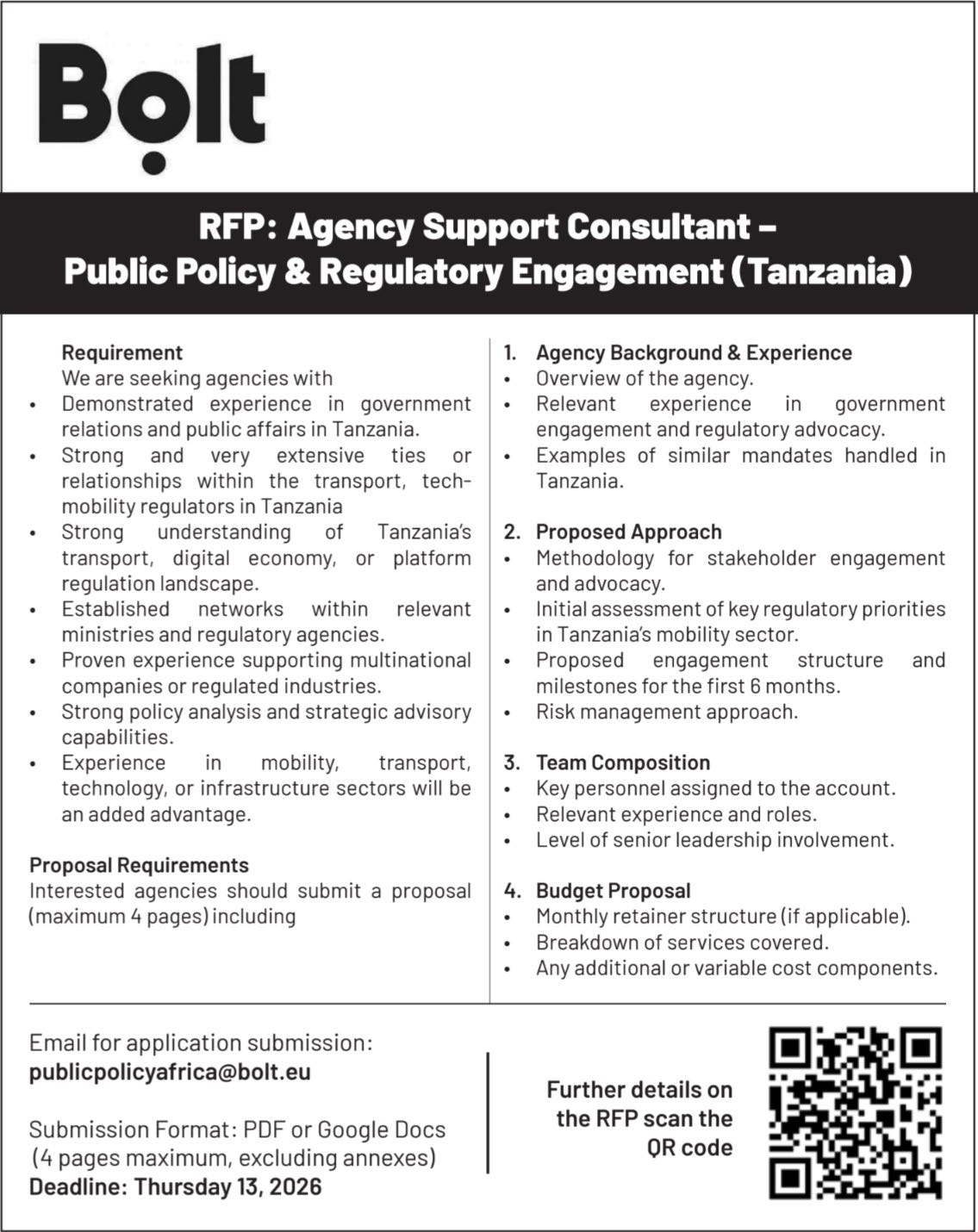
Bolt is looking for a Tanzanian public affairs agency to manage its engagement with regulators and policymakers, according to a request for proposals obtained by Atoms & Bits today.
The selected firm will handle regulatory intelligence, stakeholder mapping, and structured advocacy.
Dimmy Kanyankole Senior General Manager for Bolt East Africa, described what the company needs: “We’re looking for a public policy agency or consultant. It’s an interesting role to help shape the ride-hailing industry.” Proposals are due March 13 at publicpolicyafrica@bolt.eu.
The RFP asks for an agency with established networks inside the Ministry of Transport and LATRA, a documented history of success supporting multinationals in regulated industries, and a credible six-month engagement plan with senior leadership involvement.
Bolt has operated in Tanzania since 2017, when it launched as Taxify, and employs more than 30,000 drivers across eight cities and towns.
Rides grew 68% year-on-year in 2025. Its corporate travel division grew 213% and achieved a 56 percent rise in gross merchandise value, with banking and telecom companies leading adoption, followed by legal firms and courier services.
The company has expanded beyond Dar es Salaam and Dodoma into Moshi, Morogoro, Kahama, Zanzibar, and Arusha, a growth trajectory that Kanyankole, who previously served as group head of retail at pan-African payments company Cellulant, has managed through a data-intensive approach.
His team tracks over 300 daily metrics covering driver supply, demand, retention, and earnings, as we reported in Atoms & Bits Magazine (May-June 2025).
That growth has happened alongside a regulatory environment that has twice forced the industry into open dispute.
In March 2022, LATRA ordered platforms to cap driver commissions at 15%, a directive that arrived without prior industry consultation and that prompted Uber, then charging 25%, to suspend operations immediately.
Bolt, at 20%, temporarily pulled its car category while negotiating revised terms. LATRA settled at 25% by December that year.
The current framework fixes per-kilometer rates between Sh800 and Sh1,000, caps booking fees at 3%, and prohibits surge pricing, parameters that apply uniformly to every platform regardless of size.
Uber returned after the 2022 settlement and left permanently in January 2026, with its local leadership citing an operating environment that could not support the business.
Analysts who covered the exit, such as The Citizen and TechCabal, noted that the company’s difficulties were partly structural and partly a failure to build the kind of local relationships that would have given it advance notice of regulatory shifts.
Bolt, by contrast, absorbed each disruption and grew through them. The question the RFP implicitly answers is why reactive management, however successful, has limits.
Driver complaints have persisted even within the current framework. In October 2024:
Drivers protested outside Bolt’s Dar es Salaam offices over deductions they described as too high,
LATRA convened a stakeholders’ meeting and requested a written explanation from the company, and
Bolt held a press briefing in February where it clarified that its charges comply with LATRA’s 25% cap and that total deductions do not reach 30%.
Some drivers dispute the math. Others say the complaints reflect how platform discount structures are explained to them rather than what is actually charged.
Riders occupy a different position in the same argument, since the 2022 fare revision that made driver economics more viable also raised what passengers pay per trip.
For Bolt, regulation is a central factor in assessing both the attractiveness of new markets and the potential for growth in existing ones, with the key question being whether the regulatory environment can support driver supply and whether the investment needed to meet compliance requirements is worth it over time.
Tanzania is the market where that calculation has been tested most visibly on the continent, and the outcome has shaped how other African regulators approach the sector.
The EU Platform Work Directive, passed in 2024, has added a parallel track to that conversation globally by establishing employment classification standards for gig platform workers (like Bolt drivers) and requiring member states to presume them as having employment status unless companies demonstrate otherwise.
Several African regulators have cited European precedent in shaping their own frameworks, and LATRA’s approach to fare and commission regulation already draws from the same logic: that platform workers deserve the protections extended to other categories of transport labor (such as bus and truck drivers).
How Tanzania resolves the tension between those principles and a business model built on independent contractors will influence how the region regulates the sector going forward.
Bolt is also running electric vehicle pilots that sit directly in that policy space.
Its partnership with Green Wheels on electric motorcycles in Arusha and with TRÍ and Watu on electric three-wheeler taxis in Dar es Salaam both benefit from the Finance Act 2023’s elimination of excise duties on electric three-wheelers, and both depend on a stable relationship with the same regulators who set fare and commission policy.
Senior Country Manager for Bolt Business Milu Kipimo has described the company’s direction as paving the way for more efficient and environmentally sustainable transport, with corporate clients reporting transport expense reductions of nearly half since moving to the platform.
Local platforms including Faras, Kiliride, and Paisha each operate in segments that Bolt has been slower to prioritize, and InDrive has grown a following by letting riders and drivers negotiate fares directly rather than operating inside LATRA’s fixed rate structure.
The regulatory decisions that shape what any platform can charge and how drivers are classified will determine how much space each of those alternatives has to grow, which is why the agency that wins Bolt’s brief will not only be ‘working for’ one client.